Seite 9
Prof. J. WALTER Kurstitel
Stand: Januar 2000



Bus-Architektur
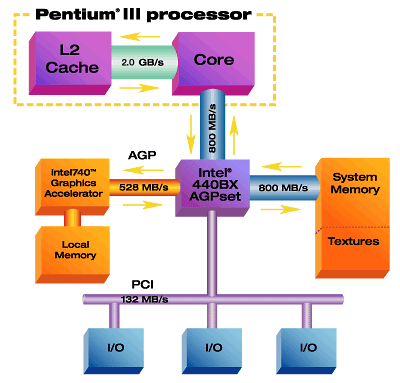
| Fast
floating-point performance smooths the drawing of 3D meshes and animation
effects and adds depth complexity to the scene. The next step is to add
lifelike realism and depth. To do this, the PC must render the 3D images by
adding textures, alpha-blended transparencies, texture-mapping lighting, and
other effects. AGP technology accelerates graphics performance by providing a
dedicated high-speed port for the movement of large blocks of 3D texture data
between the PC's graphics controller and system memory. Scaling to Even Higher Bandwidth The AGP interface, positioned between the PC's chipset and graphics controller, significantly increases the bandwidth available to a graphics accelerator (current peak bandwidth is 528 MB/s). AGP lays a scalable foundation for high-performance graphics in future systems, with support for a peak bandwidth over 1 GB/s. Today's 3D applications have a huge appetite for memory bandwidth. By providing a high memory bandwidth "fast lane" for graphics data, AGP enables the hardware-accelerated graphics controller to execute texture maps directly from system memory, instead of caching them in the relatively limited local video memory. It also helps speed the flow of decoded video from the CPU to the graphics controller. 3D applications will also run faster when the need to pre-fetch and cache textures in local video memory is eliminated. By minimizing the need for video memory, AGP helps developers control the costs of new designs. Removing video traffic from the PCI bus also delivers better stability. Boost Your AGP Learning Curve Take a few moments to explore AGP technology in our AGP Tutorial. It outlines what you need to know about PCs and software applications optimized for AGP. Hardware developers who need to drill down deeper can download the AGP Interface Specification version 2.0 and the latest engineering revisions. Further detailed information on electromechanical implementation issues and thermal design guidelines is available in the newly updated AGP Platform Design Guide revision 1.1. |